
If you have a horse-crazy kid, you have probably been handed a piece of paper at some point and asked to draw a horse — and if you’re anything like me, what came out looked more like a dog with a thyroid problem than an actual horse.
Horses are genuinely one of the hardest animals to draw. The proportions are weird until you know the trick, the legs bend in places that don’t feel intuitive, and there is a very fine line between “noble steed” and “sad llama.” So I did some digging, practiced with my daughter, and figured out a simple way to break it down that actually works — even for kids, even for parents who swear they can’t draw a straight line.
Start With Shapes, Not a Horse
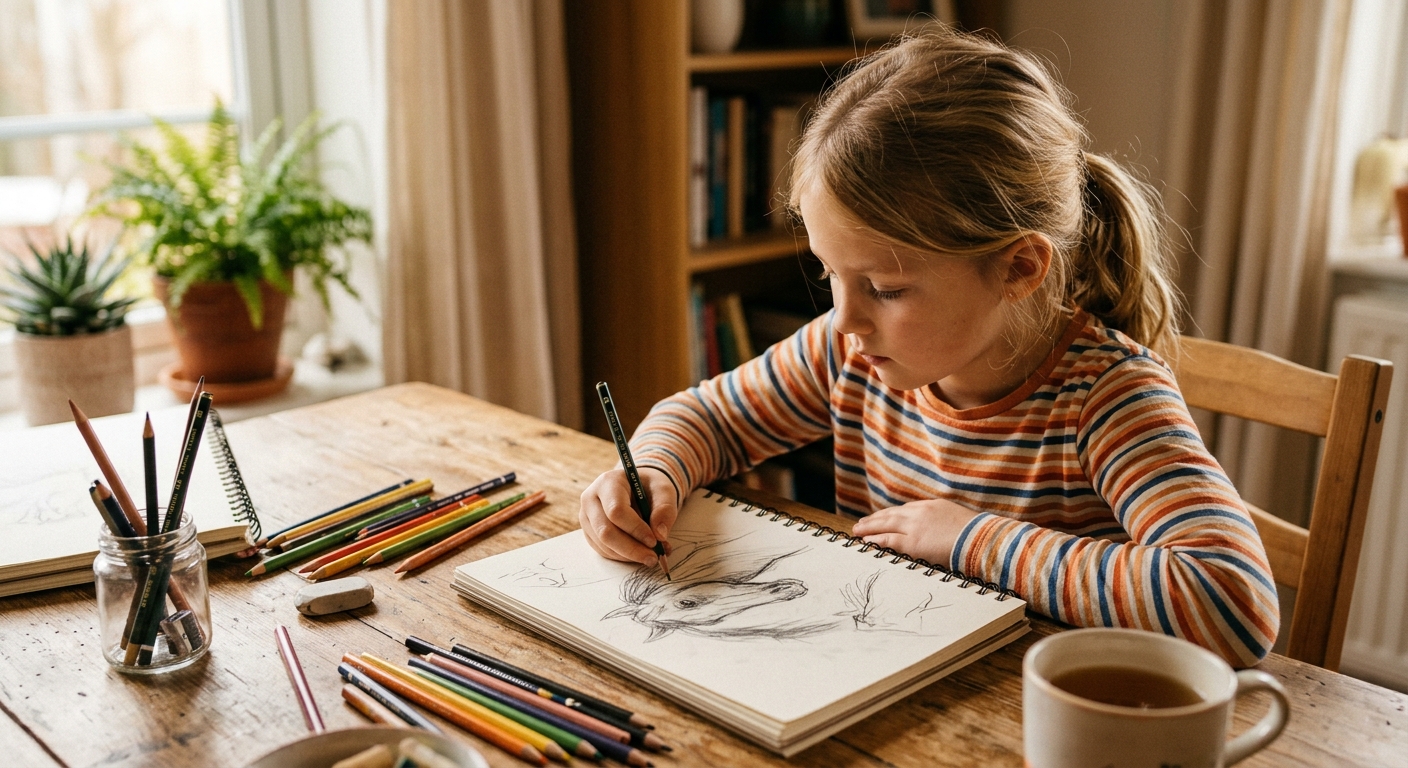
The biggest mistake people make is trying to draw the outline of a horse all at once. Instead, start with basic shapes:
- One oval for the body (slightly angled, longer than it is tall)
- One smaller oval for the head, connected by a curved neck shape
- Four thin rectangles for the legs, evenly spaced under the body
This “shape skeleton” is the secret. Once the basic proportions are blocked in, the actual horse shape almost draws itself on top.
Get the Legs Right
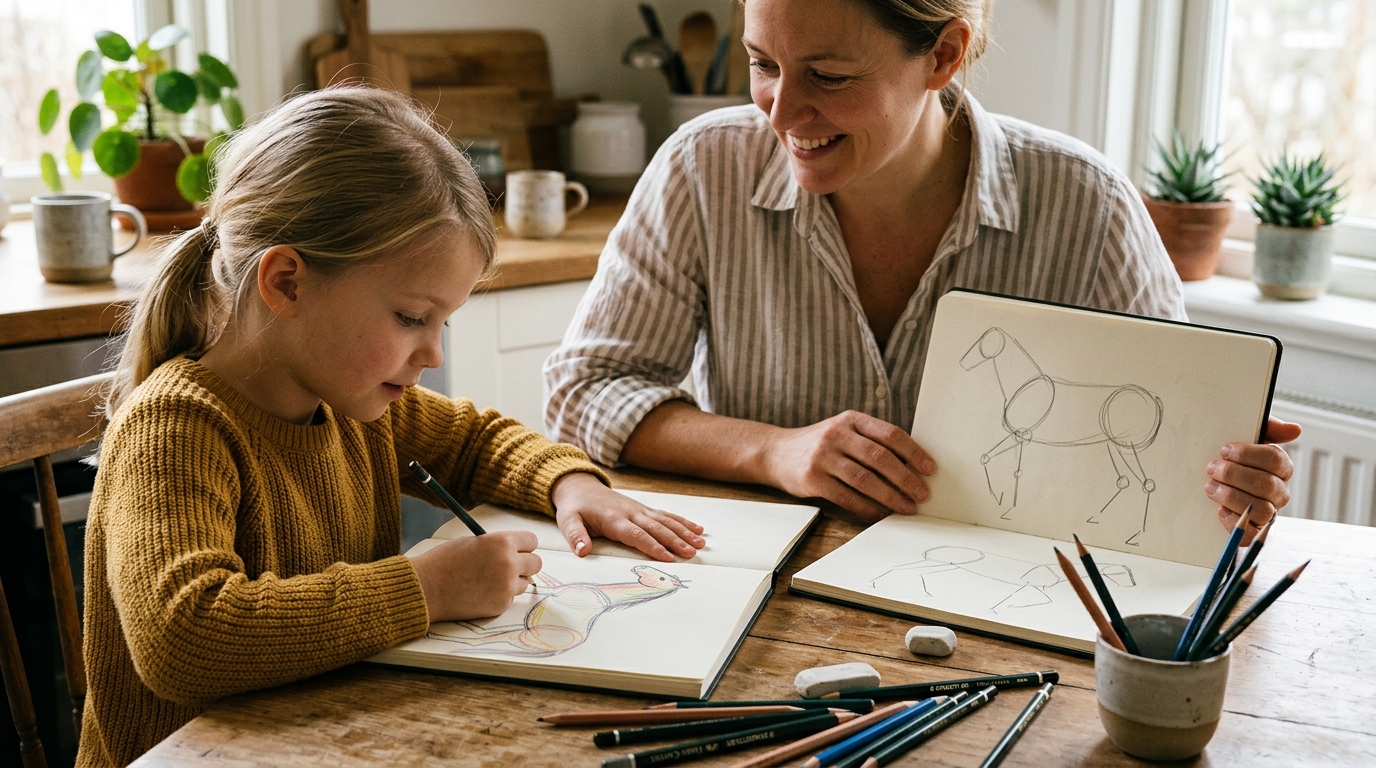
Horse legs are where most drawings go wrong. The key thing to remember: a horse’s “knee” partway down the front leg is actually closer to a wrist, and the joint that looks like a backward knee on the hind leg is actually the ankle. Once you stop trying to make the legs bend like human legs, they start looking right.
A simple trick that helped my daughter: draw each leg as two straight lines connected by a small angle, rather than one curved line. Horses have surprisingly straight, thin legs — it’s the angles that make them look natural.
The Head Is Mostly About the Nose
A horse’s head is essentially a long rectangle with rounded corners. The ears go on top like two little triangles, and the most important part — the part that makes or breaks whether it looks like a horse — is the length of the nose/muzzle. Horses have a long face. If you shorten the nose, you get a pony-shaped dog. Let it run long, and suddenly it reads as a horse.
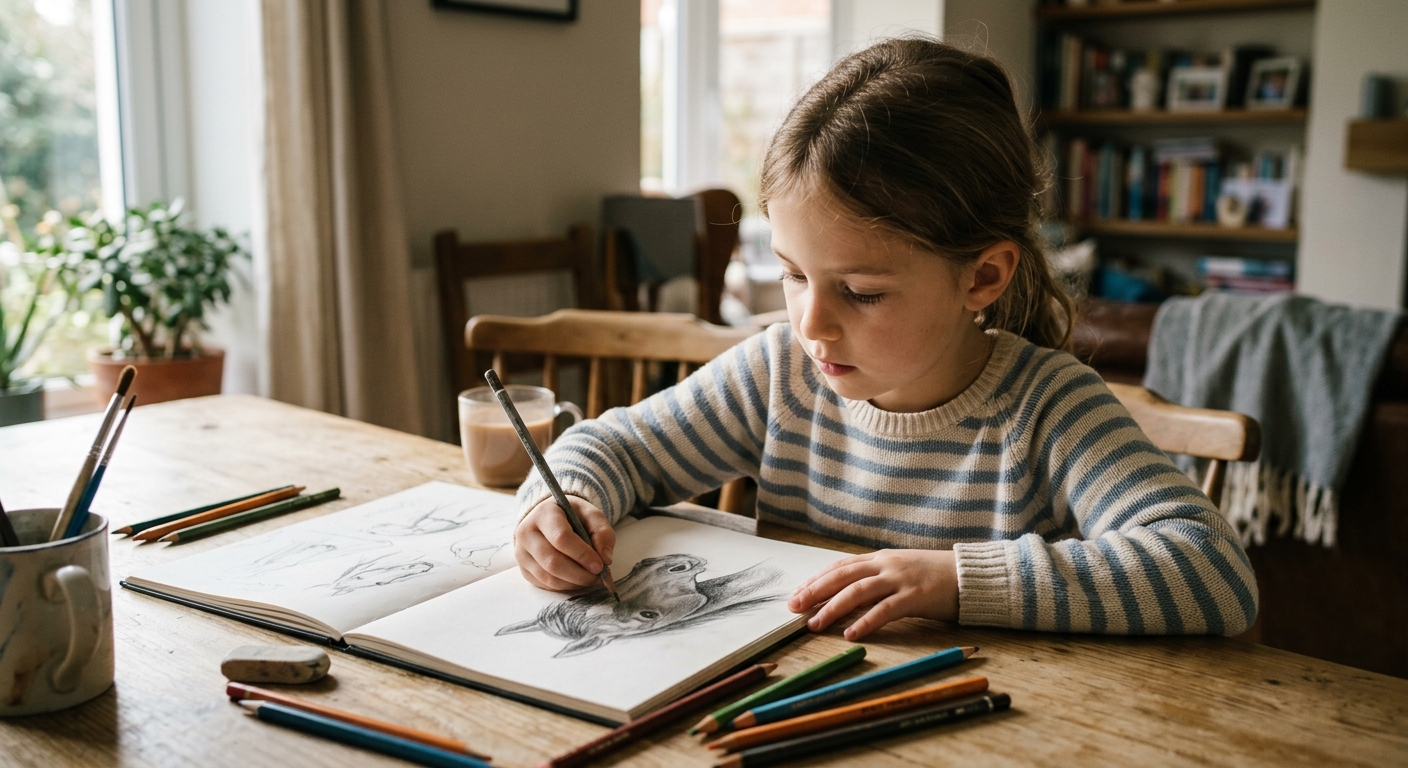
Add the Mane and Tail Last
Manes and tails are forgiving — they cover up a lot of small proportion mistakes underneath. A flowing, wavy mane along the neck and a few long curved lines for the tail instantly make any horse drawing look more finished and alive.
Speaking of which — if your kid loves horses but isn’t quite ready to draw one freehand yet, I made a set of 30 printable horse coloring pages that are perfect for practicing shading, color choices, and just enjoying horses on paper without starting from a blank page.
Quick Step-by-Step Checklist
- Block in the “shape skeleton” — one oval for the body, a smaller oval for the head, four thin rectangles for the legs
- Fix the leg joints — draw each leg as two straight lines meeting at an angle, not a curve
- Shape the head — long rectangle with rounded corners, triangle ears, and a long muzzle
- Add the mane and tail last, using flowing curved lines
- Erase the guide shapes and clean up the final outline
Frequently Asked Questions
What’s the most common mistake when drawing a horse?
Shortening the muzzle. A too-short nose is what makes a horse drawing look more like a dog or a pony-shaped blob.
Is this method good for younger kids?
Yes — the shape-skeleton approach works well for beginners of any age since it breaks a hard subject into simple, forgiving steps.
My kid isn’t ready to draw freehand yet — any alternative?
Coloring an already-drawn horse is a great in-between step. Our 30 printable horse coloring pages work well for that.
Drawing horses takes practice, and even after lots of it, some days the legs still come out looking like noodles. That’s part of the fun. Keep a sketchbook in the car for barn-lesson waiting time, and watch how fast horse drawings improve when a kid actually loves what they’re drawing.
Does your horse-crazy kid love to draw too? I’d love to see how their horses turn out — share this with another barn mom whose kid draws horses on every available surface!